Why Compare Silver to Gold?
Why compare silver to gold specifically, rather than to oil, copper, the S&P 500, or inflation? Here is why gold is the unique and necessary benchmark for silver investors.
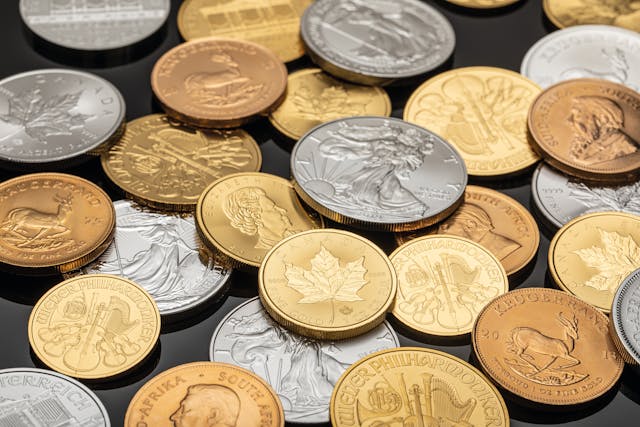
Both are historical sound money — monetary twins
For thousands of years, gold and silver functioned as the world’s primary monies, often in a fixed ratio (e.g., 16:1 in the US bimetallic standard). Gold remains a cornerstone of central bank reserves; silver, while historically held alongside it, has largely exited official reserve holdings in the modern era.
This shared monetary history means their relative value is anchored by human psychology and institutional memory in a way no other commodity pair is. Copper is industrial; oil is energy; stocks are claims on future earnings. None have a 5,000-year track record as money.
They move in tandem over long periods, then temporarily diverge
Over decades, gold and silver prices are highly correlated. When the ratio deviates widely, it is not because their fundamental drivers diverged permanently, but because of temporary market sentiment — fear, liquidity crunches, or speculative manias. Historical patterns strongly suggest reversion, as the two metals remain economic substitutes in monetary contexts.
- Silver vs. Copper: Copper is purely industrial. Silver sometimes acts like copper (during economic booms), but sometimes acts like gold (during flights to safety). The relationship is inconsistent and non-mean-reverting.
- Silver vs. S&P 500: No stable long-term ratio exists. Stocks can rise indefinitely in nominal terms; silver cannot. The ratio has no historical anchor.
- Silver vs. Oil: Oil is consumable and geopolitically driven. There is no monetary link.
The ratio isolates monetary sentiment from industrial demand
Silver is unique: roughly 55–60% of its demand is industrial (a share rising due to solar panels and electric vehicles), while 40–45% is monetary — spanning jewellery, private investment, and store-of-value demand. Gold is approximately 90% non-industrial.
- When the ratio spikes, investors are fleeing all monetary assets, but gold holds value better due to liquidity preference. Silver is sold off more sharply because its industrial component amplifies panic.
- When confidence returns, silver’s smaller market cap and industrial leverage cause it to rally faster than gold, collapsing the ratio.
It provides a clean historical trading range
No other asset-silver pair offers a bounded, historically consistent range. The silver/copper ratio varies without a consistent range; silver/oil is similarly unanchored. That relative boundedness is what makes the gold/silver ratio a tool rather than just a statistic.
| Ratio | What it tells you | Limitation |
|---|---|---|
| Silver / Gold | Monetary sentiment; relative value of the two monetary metals | None — this is the actionable benchmark |
| Silver / Copper | Industrial substitution dynamics | Useful for a copper miner, not a monetary investor |
| Silver / Inflation | Whether silver preserves purchasing power | Useful for wealth preservation; does not generate trade signals |
| Silver / S&P 500 | Risk appetite | No reversion to a historical mean |
| Silver / Oil | Commodity cycle dynamics | No monetary link; varies without a consistent range |
Bottom line
Gold is not just another asset for comparison — it is silver’s monetary twin. No other benchmark captures the full picture of silver’s dual nature as both an industrial metal and a monetary asset.